Movie context
Peddi
Song focus
Chikiri Chikiri
Song focus
Hellallallo
About this article
This is the first article on Mani's POV. It reflects a personal learning journey — not a final answer, but a sincere attempt to question public culture more responsibly.
Where this article begins
I am writing this as my first article on Mani's POV, not because I think I know everything, but because I want to educate myself.
Sometimes we watch something, enjoy it, dance to it, laugh at it, quote it, or celebrate it without thinking too deeply in that first moment. Then later, when someone explains the meaning behind a lyric, a scene, a dialogue, or even a camera angle, something changes. We begin to ask ourselves: what exactly did I just enjoy, and why does it suddenly feel uncomfortable?
That is where this article begins.
This is not written to hate any actor, singer, lyric writer, music director, director, heroine, producer, fan, or film industry. This is not about attacking one person. It is about questioning the words, visuals, and cultural habits we normalize in the name of entertainment.
Because entertainment also teaches us something, even when we do not notice it immediately.
“
Mani's POV is not about claiming I know everything. It is my learning space.
I write to educate myself first. When I understand an issue better, I share my POV so others can question, discuss, correct, and learn with me. This website is about learning publicly, questioning responsibly, and growing through discussion.
I enjoyed the beat first
I want to be honest about that.
Like many people, I notice the beat first. I notice the music, the voice, the dance, the star presence, the energy, and the excitement around a song. That is usually what reaches us first. It is what makes people share reels, talk about a track, and celebrate it before they even stop to think.
But after that first excitement, when I started listening more carefully, I began to feel uncomfortable.
Not because someone forced me to hate the song. Not because I suddenly became anti-cinema. But because I started understanding that lyrics are not just sounds.
Words carry meaning.
Visuals carry meaning.
Performance gives that meaning reach.
A song can be catchy and still be problematic. A voice can be powerful and still carry harmful words. A dance can be energetic and still amplify a bad message.
Misogyny is not always obvious
One thing I am learning is that misogyny is not always loud or obvious.
It is not only someone openly saying that they hate women. It can be much more subtle than that.
It can hide in jokes, dialogues, songs, lyrics, camera angles, choreography, and the way female characters are written.
When a woman is treated like an object, that matters. When she is reduced only to body, beauty, curves, or desire, that matters. When she exists only to elevate a hero, that matters. When romance begins to sound like a bargain or a transaction, that matters.
This is not overthinking. This is trying to understand impact.
Why this matters
Entertainment teaches quietly
A song can become part of public language before we even stop to understand what it is saying.
Objectification becomes normal
When women are repeatedly reduced to body, beauty, or desire, it starts feeling harmless even when it is not.
Learning changes listening
Sometimes someone explains the meaning, and the same beat begins to feel different.
The lines that made me question
Short excerpts, bigger patterns
The issue for me is not one single word alone. The issue is the pattern. When women are repeatedly described through objectifying language, body-gaze, or transactional romance, it stops feeling harmless.
Chikiri Chikiri
సరుకు సామాను…
Why it worries me
This treats the woman like goods or items instead of a person. A woman is not something to be checked out like a product.
Beat baagundi ani “సరుకు సామాను” meaning marchipovala?
ముందు వెనుకా…
Why it worries me
This creates a front/back body-gaze feeling. It reduces the woman's presence to body shape and physical attraction.
Music catchy ani “ముందు వెనుకా” body-gaze ni ignore cheyyala?
కళ్లేసి… లొట్టేసి…
Why it worries me
This normalizes staring, lust, and drooling male gaze. It makes the woman sound like something to be visually consumed.
Steps adirayi ani “కళ్లేసి… లొట్టేసి…” male-gaze ni entertainment ga teesukovala?
ఒళ్లంతా ఒంకీలు…
Why it worries me
This shifts focus strongly toward the woman's body and curves instead of treating her as a full person.
“ఒళ్లంతా ఒంకీలు” ani body ni main focus chesi adhi romance ani pilavala?
నీ సింగారాన్ని…
Why it worries me
This presents her mostly as visual pleasure, not as a character with presence, voice, or agency.
“నీ సింగారాన్ని” ani beauty ni celebrate cheyyadam veru, objectification veru kadha?
Hellallallo
వారానికి వెయ్యి…
Why it worries me
This brings money into the language of intimacy. It gives romance a transactional tone.
Song viral ayindi ani “వారానికి వెయ్యి” transactional tone ni normal ga teesukovala?
నీకిట్టా ఈ హాయి…
Why it worries me
This frames pleasure as something being offered in a suggestive way. In context, it does not feel innocent.
Voice powerful ani “నీకిట్టా ఈ హాయి” suggestive meaning ni pakkana pettala?
అరకాసులు తియ్యి…
Why it worries me
This sounds like bargaining or payment. It makes intimacy sound like a deal.
Lyrics folk style lo unnayi ani “అరకాసులు తియ్యి” bargain feeling ni excuse cheyyala?
స్వర్గానికి దారి…
Why it worries me
This uses pleasure-coded language in a way that makes romance feel more like temptation than mutual affection.
“స్వర్గానికి దారి” suggestive ga unte adhi automatic ga fun aipothunda?
చీర చొక్కా చిక్కడిపోవాలో…
Why it worries me
This adds a strong physical and intimate suggestion to the tone of the song.
“చీర చొక్కా చిక్కడిపోవాలో” physical suggestion ni harmless fun ani vadileyala?
Important
This is not about blaming the heroine.
I want to say this clearly. This is not about blaming the heroine.
Most of the time, the heroine does not control the lyrics, the writing, the camera angles, the choreography, the editing, the marketing, or the final cut. So my question is not: why did she do this?
My question is: why is the female lead being written like this? Why is she being styled like this? Why is she being shot like this? Why is she being promoted like this? Why does her dignity become secondary when a song wants to create mass energy?
A heroine can be glamorous and still be respected. A mass song can exist without objectifying women. A love song can be memorable without reducing a woman to fantasy.
Responsibility is shared
Meaning travels through a chain
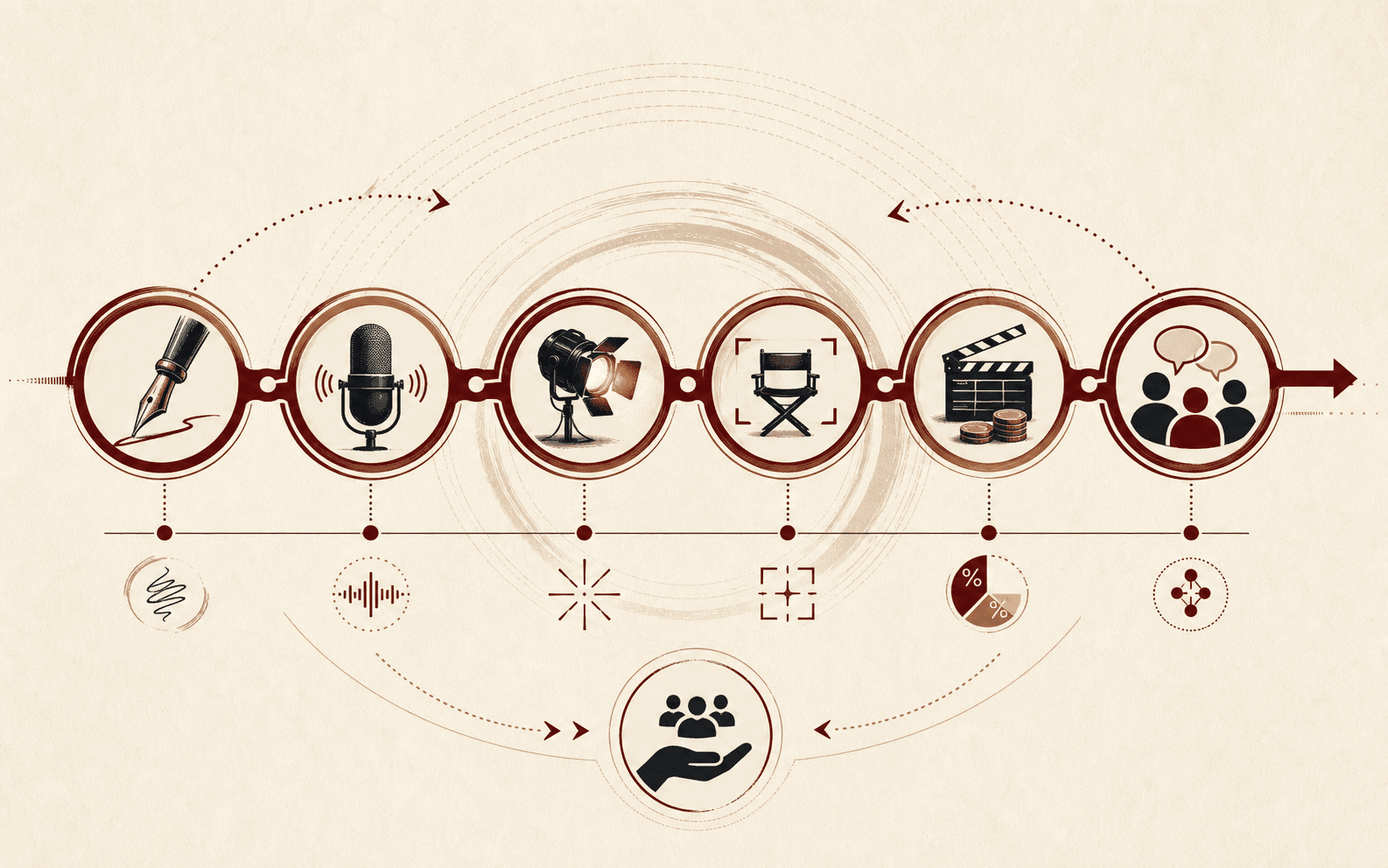
01
Writer
02
Singer
03
Actor
04
Director
05
Producer
06
Audience
If a writer writes a line, that line becomes culture. If a singer gives voice to it, that voice carries meaning. If an actor performs it, the performance gives it reach. If a director approves it and producers promote it, cinema becomes public influence. If fans celebrate it blindly, the problem gets normalized.
This does not mean everyone involved is a bad person. It means everyone involved is part of the chain through which meaning travels. And if meaning travels through the whole chain, accountability should too.
Thanks to the people who helped me understand
Thank you to all the YouTube channels, creators, reviewers, critics, women, audience members, and social media voices who spoke about these issues and helped people like me understand them better.
Not one channel alone. Not one person alone. Many people questioned it. Many people explained it. Many people made others stop and think.
Sometimes we enjoy the beat first. Then someone explains the meaning. Then we notice the gaze. Then we realise why it feels wrong.
That process matters. Education often begins exactly there.
This website is also part of that process for me. I am not writing as someone who has all the answers. I am writing as someone who wants to ask better questions and learn through discussion.
My POV
Mass ante misogyny kaadu.
Folk ante vulgarity kaadu.
Romance ante transaction kaadu.
Entertainment ante women ni object laga chupinchadam kaadu.
Real mass is respect. Real music has rhythm and responsibility. Real cinema can create craze without reducing women to body, beauty, bargain, or fantasy.
This is not hate. This is accountability.
This is not cancel culture. This is not anti-cinema. And for me, this is also education. I am writing to educate myself first. When I understand an issue better, I want to share my POV so others can question, discuss, correct, and learn with me.
That is why I started Mani's POV.
Learning publicly. Questioning responsibly.
Sources / Context
This article is based on publicly available song videos, lyrics references, and my personal interpretation after listening, watching, and learning from public discussion. I am not claiming a final verdict. If any meaning or context is misunderstood, readers can correct or add context through email, X, or a future article-specific Google Form.
Chikiri Chikiri official video context - T-Series Telugu / YouTube
Context link used to identify the public song/video/lyrics reference. My criticism in this article is personal interpretation, not a claim of final fact.
Open sourceChikiri Chikiri song credits/listening page - Spotify
Context link used to identify the public song/video/lyrics reference. My criticism in this article is personal interpretation, not a claim of final fact.
Open sourceChikiri Chikiri lyrics reference - LyricsGenesis
Context link used to identify the public song/video/lyrics reference. My criticism in this article is personal interpretation, not a claim of final fact.
Open sourceHellallallo video context - Times of India
Context link used to identify the public song/video/lyrics reference. My criticism in this article is personal interpretation, not a claim of final fact.
Open sourceHellallallo lyrics reference - WorthvieW
Context link used to identify the public song/video/lyrics reference. My criticism in this article is personal interpretation, not a claim of final fact.
Open sourceHellallallo lyrics reference - KKM Lyrics
Context link used to identify the public song/video/lyrics reference. My criticism in this article is personal interpretation, not a claim of final fact.
Open sourceJoin the discussion
Agree, disagree, question, or add context — this space is part of my learning too. For now, email me or connect on X. When an article-specific Google Form is ready, it can sit here.
Discussion form not connected yet
Send suggestions, sources, or corrections directly
A public Google Form has not been added yet. Until it is connected, readers can still share public issue suggestions, source links, corrections, disagreement, or discussion interest through the working contact paths below.
Continue on X
Follow Mani or share this article for public discussion.